Following musicians on Twitter is a fun way to get a peek into the life and minds of some of my favorite artists. If you haven’t seen it yet, there is a gigantic spreadsheet of musicians on Twitter. But it’s (increasingly) hard to find artists who are interesting to follow.
In general, my criteria for who to follow are: i) it’s an artist that I like and respect, ii) their Twitter postings do not come via a PR firm, iii) they are more than just lists of upcoming gigs, iv) their posts are reasonably literate and grammatical, and (most importantly, and also most subjectively), they have interesting things to say.
Here are my three favourite artists that I’m following on Twitter:
@tedleo (Ted Leo, he of the Pharmacists): Not surprisingly, the hyper-articulate songwriter writes interesting Twitter posts, mostly a mix of the musical, political and the quotidian.
@trentreznor (Trent Reznor of Nine Inch Nails): I think one of my favorite tweets ever is Trent Reznor’s plaintive and clueless (and entirely leg-pulling) query about his screen going blue and freezing up, which I imagine elicited much sympathy and helpful advice.
And the top three people I’d love to see on Twitter:
David Bowie. The real one, not the fake one with one update and nearly 12,000 followers.
John Darnielle, of the Mountain Goats. Although I’m not sure that the notably verbose Darnielle could say anything in less than 140 characters.
John K. Samson, of the Weakerthans. An excellent contender for the laurel of Canada’s Poet-Laureate, once Leonard Cohen decides he no longer wants the job.
Your turn – who do you follow, and why? And who would you like to see on Twitter?
After four years in production, Speaking in Code, a vérité-style documentary about the world of techno, is set to hit the big screen. The film features techno artists such as Modeselektor, Monolake, Wolfgang Voigt (a co-founder of the influential Kompakt label) as well as local faces Smartypants (Mike Uzzi) and Six Million Dollar Dan (Dan Paluska). It’s set to premiere at the Somerville Theatre on Thursday, April 23rd, as part of Independent Film Festival Boston. You can buy a festival pass now, and individual tickets will be on sale shortly.
First off, the zed equals zee happy hour was a rousing success, with lots of terrific conversation. It was fantastic to meet so many Boston musicians and bloggers face to face, including some of the people behind Boston Band Crush, The Limits of Science, Electric Laser People, and Paul Lamere of Music Machinery and his colleagues at The Echo Nest. It’s a measure of how friendly the crowd was that there was waaaaaaay too much money on the table at the end of the night; if you came out last night, join us for the next zed equals zee happy hour in a few months and the first round is on us.
More news:
Activision and Red Octane have announced thatDJ Shadow is signed up to help develop and test the hardware for DJ Hero, set for release later this year. The turntablist may also appear as a playable character. There are not-terribly-substantiated rumours (which I’ll happily spread) that Daft Punk may also be involved in the new game. [via Resident Advisor]
On a related note, MTV reports that Rock Band has sold over 40 million songs, for nearly a billion dollars in revenue.
According to a recent report, live music has now overtaken recorded music in revenue in the UK (£904 million vs £896 million). Although that includes neither sponsorship revenues nor digital licensing, which makes me wonder a bit about the author’s job title of Chief Economist. No word on whether the numbers include Rock Band downloads. [NME] [EDIT: removal of unwarranted snark; see comments for details]
DIY donk.Remix any track into the Northern England sound of bouncy techno. Music Machinery’s donkified version of The Postal Service’s “Such Great Heights” made me laugh out loud, although I still had to turn it off after about 15 seconds.
Two upcoming conferences that might be of interest to z=z readers, one on each coast.
This weekend (March 27th, and 28th), Berklee College of Music is hosting the Music and Entertainment Educators Association conference. Unsurprisingly, given its audience, the schedule is a mixture of industry panels—keynotes on “The New Entertainment Economy” and on “Marketing and Distribution in the Digital World,” for example—as well as academic talks (such as “Audio Mashups and Fair Use: The Nature of the Genre, Recontextualization, and the Degree of Transformation”). The speakers include executives from Sonicbids, Topspin and Electronic Arts. You can see a full schedule here [PDF], and you can register at the conference website.
On the other coast, the San Francisco Music Tech Summit is scheduled for May 18th at the Hotel Kabuki in Japantown. Scheduled speakers include Dave Allen (of Pampelmoose and Gang of Four), the founder of Pandora, the director of technology of Sub Pop, and more. Again, you can register at the conference site, here.
If you can’t make either, never fear – keep an eye out for z=z reports from both conferences.
In honor of Ada Lovelace Day, which celebrates women in technology, today’s posting is focusing on women in techno. DJ’ing as a whole is incredibly male-dominated, and I thought it would be great to highlight some females who are getting the crowd moving from behind the decks.
Classically-trained pianist Kate Simko came of age in Chicago at the height of the Midwest rave scene. On the one hand, she has formal training in music technology and composition; conversely, she was a key player in the Chicago electronica scene, including hosting the well-known Chicago night, Wake Up! Her own tracks reflect her roots in both Chicago house and Detroit techno.
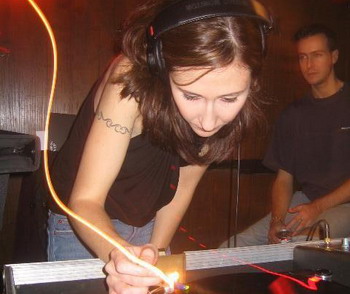
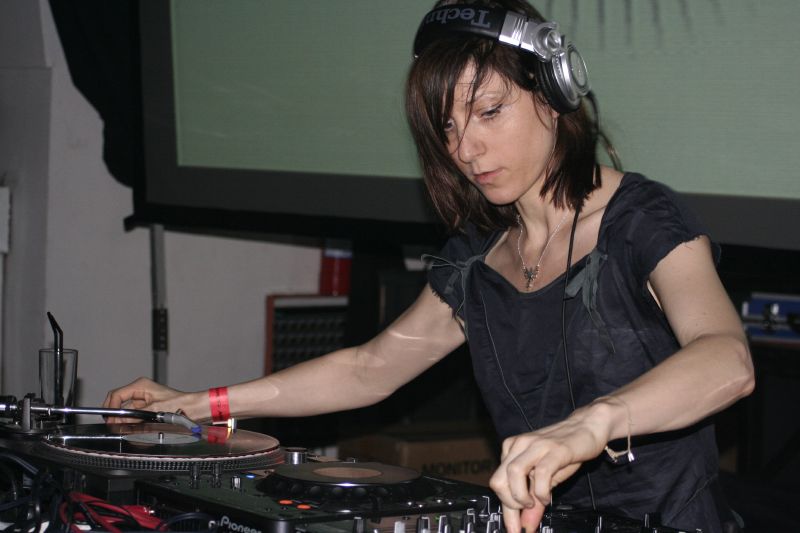
Techno DJ and producer Ellen Allien (pictured) is based in Berlin. She organized the BPitch parties there and eventually started her own label, BPitch Control. She’s released several solo albums as well as a collaboration with Apparat, and her own compositions are experimentally-oriented techno/electro hybrids.
Finally, Seattle’s own Chloe Harris is best known for her DJing (including touring with John Digweed), for her show on Proton Radio, and for mixing up her genres to make her unique sound. She’s just started creating her own tracks, and here’s one of them.
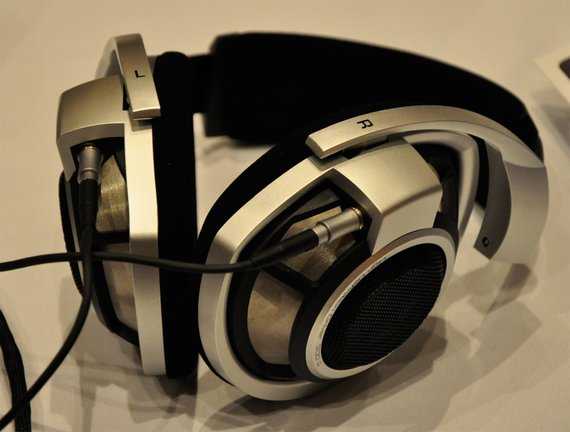
Ever wondered how ultra-high-end headphones are made? CNet UK went on a tour of the Sennheiser factory in Hanover, Germany to watch the fabrication of their HD 800 headphones, and they are sharing a photo tour. It’s pretty cool – while some parts are shipped to the factory from elsewhere, all of the electronics are assembled in-house, by hand, and only fifty pairs are made each day.
If you have (or are thinking of getting) a pair of these babies, you damn well better be able to tell the difference between MP3 bitrates and you’d better prefer higher-fidelity music. Otherwise, me and a crack team of my music-loving friends will have to come to your house and administer a stern talking-to.
Photo tour of the factory here, and a review of the HD 800s here.
Okay, these guys get full bonus points for intrigue (not to mention snark).
An excerpt from the e-mail I received today, from one Quentin Coward (all links are mine):
This year, as for several years, “The X-Factor” and its coven of related “reality” shows such as “American Idol” have been a subject of much debate, controversy and – in many musical circles – derision.
This year in particular, this began to rub a lot of people up the wrong way.
Hundreds of campaigns, backing alternatives from Jeff Buckley (whose version of Hallelujah in fact reached Number 2) to Rick Astley to Peter Kay to Terry Wogan to Chris Difford from Squeeze launched across social networking sites, radio and TV stations and press outlets.
“The X-Factory” is a response, from a group of musicians who are, for the time being, keeping their identity to themselves. They are also refusing to share their sandwiches.
The mission statement was simple and two-fold:
1.) The project budget must at no time exceed £15.
2.) Real instruments and players must be used at all times.
Also, it had to be fun. We had fun. And we hope you do too.
I think it’s highly likely that the artists involved are not quite as famous as the ones they cited, and I appreciate this mostly as a creative and humorous guerrilla marketing campaign.
If sarcastic folky Brits are up your alley, you may also appreciate Mitch Benn‘s musical takedown of James Blunt, which I think is rather wittier, both musically and lyrically (“he’s the only man alive who’s his own rhyming slang”).
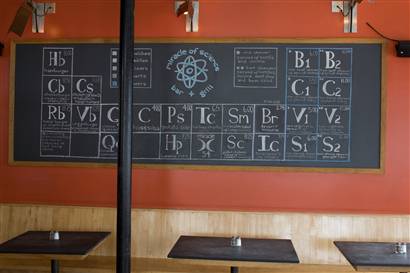
Put it on your calendars, everyone – the first official zed equals zee Happy Hour has a date! Join myself, guest blogger Scott, and intrepid correspondent Tim Smith at the Miracle of Science on Monday, March 30th, from 6 to 8 pm. I’ve talked to the bar about taking over their stereo for a playlist of z=z faves from Boston, Seattle, and beyond.
I’m looking forward to putting some faces behind the usernames, and we’d love if you can join us. RSVPs to me or in the comments are appreciated for planning purposes, but are by no means necessary.
Okay, we are going to do a quasi-scientific study here with the z=z community, to see if people can hear the difference between 128 kbps and 320 kbps audio streams. Go to mp3 or not, listen to the two sound samples, decide—or guess—which one is at the higher bitrate, and then post your results in the comments, along with any ancillary information (like whether you used speakers or headphones). I couldn’t tell the two samples apart, at least not on my laptop speakers, but I had a 50-50 shot at getting it right, and I did. Let’s see if we can get enough numbers to exclude (or confirm) randomness.
UPDATE(Friday, 10:23 am PDT): We are up to 6 people who got it right and 5 people who got it wrong. I’d love to get some more datapoints. Please share this link and ask people to comment or to send me an e-mail or a tweet.
UPDATE(Friday, 10:49 am PDT): A poll! This is much easier. If you’ve already responded in the comments, please do not vote in the poll.
A really neat exercise from the fantastic music-tech blog, Music Machinery. Using a set of software tools that allow you to manipulate audio, Paul Lamere analysed a number of songs to try to determine if the drummer used a click track or not. The basic idea was to average the tempo over the course of the tune, and then look at each beat to see if it deviated from where it was ‘supposed’ to fall. He then plotted the deviation, in seconds, as a function of elapsed time in the song. You can see an example above, for Weezer‘s song “Troublemaker.” The hills and valleys suggest that their drummer wasn’t using a click track; it contrasts sharply with the graphs for Britney Spears’s “One More Time” and Nickelback’s “Never Again,” which were pretty much flat.
If you’re interested in the details, check out the original post here, where there are plots for many more songs. And make sure you take a look at the comments – there are a lot of interesting suggestions and thoughts there. In particular, someone ran the code on a Rush song, since Neil Peart has a reputation for being almost inhumanly precise; as you’d expect, the peaks and valleys were much shallower than most of the other drummers, but not quite as flat as the bands that used (or were presumed to use) click tracks.
The Oklahoma State Legislature announced that “Do You Realize??”, by The Flaming Lips, is now the official rock song of the state (they already have a state folk song and a state country song). Democracy in action: over 21,000 people voted online for their favorite from a shortlist of ten, and the Lips got a majority of the votes (a shade over 50%). I think that’s a mandate.
Why should all your fans pay the same amount and get the same thing? We’ve talked about name-your-own-price merchandise in the context of establishing and maintaining a relationship with your fans. Here’s the other side of it: tiered pricing for music and merchandise.
I’m a huge fan of The National. I own all their CDs and bought their DVD. In the last few years, I’ve seen them in concert in Montreal, Boston (two nights in a row), and New York, and I brought people with me to all the concerts. I just bought the benefit CD Dark Was the Night, largely because it was curated by Aaron and Bryce Dessner. And, well, that’s kind of the best I can do for them.
In contrast, Amanda Palmer and Nine Inch Nails both releasedalbums that came with a wide range of extras and a corresponding range of prices. And Josh Freese is taking tiered pricing to its logical extreme, ranging from $7 for a digital download of his album to a $75,000 package that includes him joining your band (or being your personal assistant) for a month, a five-song EP written and recorded just for you, one of his drumsets, and more. For all of these artists, what you choose to pay is therefore a combination of what you can afford, how appealing each package is to you, and how much you want to support the artist. In the days of distribution via physical outlets, this wouldn’t have been an option—there would simply be no way to make sure that the right mix of regular and premium versions would go to any given record store. With direct distribution, however, matching up a fan, a pricepoint, and a package is no problem.
While it’s not a very romantic image, it’s not dissimilar to what airlines do: they maximize their revenue by selling economy-class seats at wide range of prices (ranging from full-price, walk-up seats to ultra-discounted seats sold through consolidators), which reflects what the purchaser is willing to pay. There are a couple of crucial differences, of course: one is that all of the seats are basically the same – once you’re on the plane, no one cares how much you paid for your seat, and the people who paid full price for their tickets don’t get anything extra. More importantly, in the context of art and artists, is that paying more money is not really reflective of a relationship. Much as I prefer JetBlue to its competitors, I’m not going to volunteer to pay extra for my seat to help support the airline. I would, however, pay for extra goodies to support an artist that I really like. And apparently, I’m not alone – the Who Killed Amanda Palmer? package that I wanted sold out while I was in a meeting that coincided with the preorder page going live (argh!), and Nine Inch Nail’s $300 Ultra-Deluxe Limited Edition of Ghosts I-IV sold out in 72 hours.
The dark and disturbing video for Depeche Mode‘s new single, “Wrong,” for the album Sounds of the Universe, scheduled for release on April 21 in North America. I’m not much of a video person, but this one grabbed me through to the end and then I watched it again – it hits the right balance between narrative and obliquity.
Depeche Mode’s label, EMI, seems to be aggressively policing people posting the MP3—Hype Machine leads you to a trail of dead links and deleted Blogger posts—so I decided against joining their ranks. You can purchase the single at iTunes.
In case you’re not keeping on top of Internet viral goings-on, there’s a new meme that I think is fairly interesting, conceptually. It’s nominally known as ‘Wikipedia Names Your Band,’ and the idea is to create an album cover using a randomly-generated band name (from a Wikipedia entry), album title (from a quotation), and image (from Flickr’s interestingness pool). This is clearly a descendent of the Surrealist party game, Exquisite Corpse. The difference is that, in the former version, human creativity and agency entered for each component, but the whole was randomly generated. With this Internet meme, each component is random, but the creator gets the opportunity to form a cohesive whole through graphic design. As well, our baseline expectations for record albums is fora certain amount of disconnect for the three elements; it’s the meaningful juxtapositions that violate these expectations.
Or, of course, it could just be another silly Internet meme.
Take a look at the Flickr pool and feel free to share your favorites in the comments, or create your own and tell us about it here.
The Decemberists are headlining NPR’s opening night showcase at SXSW, where they’ll be playing the entirety of their new album The Hazards of Love, scheduled for release on the 24th. Their label, Capitol Records, has teamed up with Imeem to sponsor a contest to design a poster for the show. You can find full details here.
If you’re going to be in Austin, their show is at Stubb’s on Wednesday, March 18th. Even if you’re not in Texas, you can still get in on the act; NPR will be streaming them live at their SXSW site.
Band Metrics is a semantic web start-up that lets you track your band across social media. Modeled after Google Analytics, it’s being designed to let you monitor where your music is being listened to, shared, or talked about; the image above, for example, is a graphic of plays at different sites. While tracking online statistics is not quite as glamorous as, say, hanging out in the green room drinking with groupies, Band Metrics is intended to give you the tools to track the dissemination of, and sentiments towards, your music online (since, if you have a band in 2009, you probably don’t have a manager excitedly calling you with the latest SoundScan figures).
It’s currently in private beta, but is scheduled to open to the public in a few weeks, once they sort out some kinks. You can register at their site.
[embedded YouTube video; if you can’t watch it, click here]
Library Voices had $10,000 worth of gear stolen from their tour van in Vancouver while on a tour of western Canada. The ten-piece pop collective from Regina (that’s in Saskatchewan) make a heartfelt and funny plea for its return in the video above.
Even if you don’t have any help on stolen-gear front, you should still check out their brilliant new EP, Hunting Ghosts and Other Collective Shorts. It’s a fantastic mixture of intriguing lyrics, pop hooks, and anthemic choruses.
[embedded YouTube video; if you can’t watch it, click here]
Some recommendations for this weekend in Seattle (which hasn’t been getting much z=z love recently):
Thursday, February 19th: Our new favourite local band, Hey Marseilles, has its first headlining show at Neumo’s. Doors at 7 pm. Check out the video above for a taste of their live show.
Friday, February 20th: This month’s Broken Disco, a monthly show by a collective of local electronica collectives, is the third Friday of the month at Chop Suey. This month features a DJ set by Jona (Berlin; Get Physical) and a live set by Nutownproject (Berlin; Recode/Immigrant). Doors at 9; $10 cover before 10 pm.






 zed equals zee